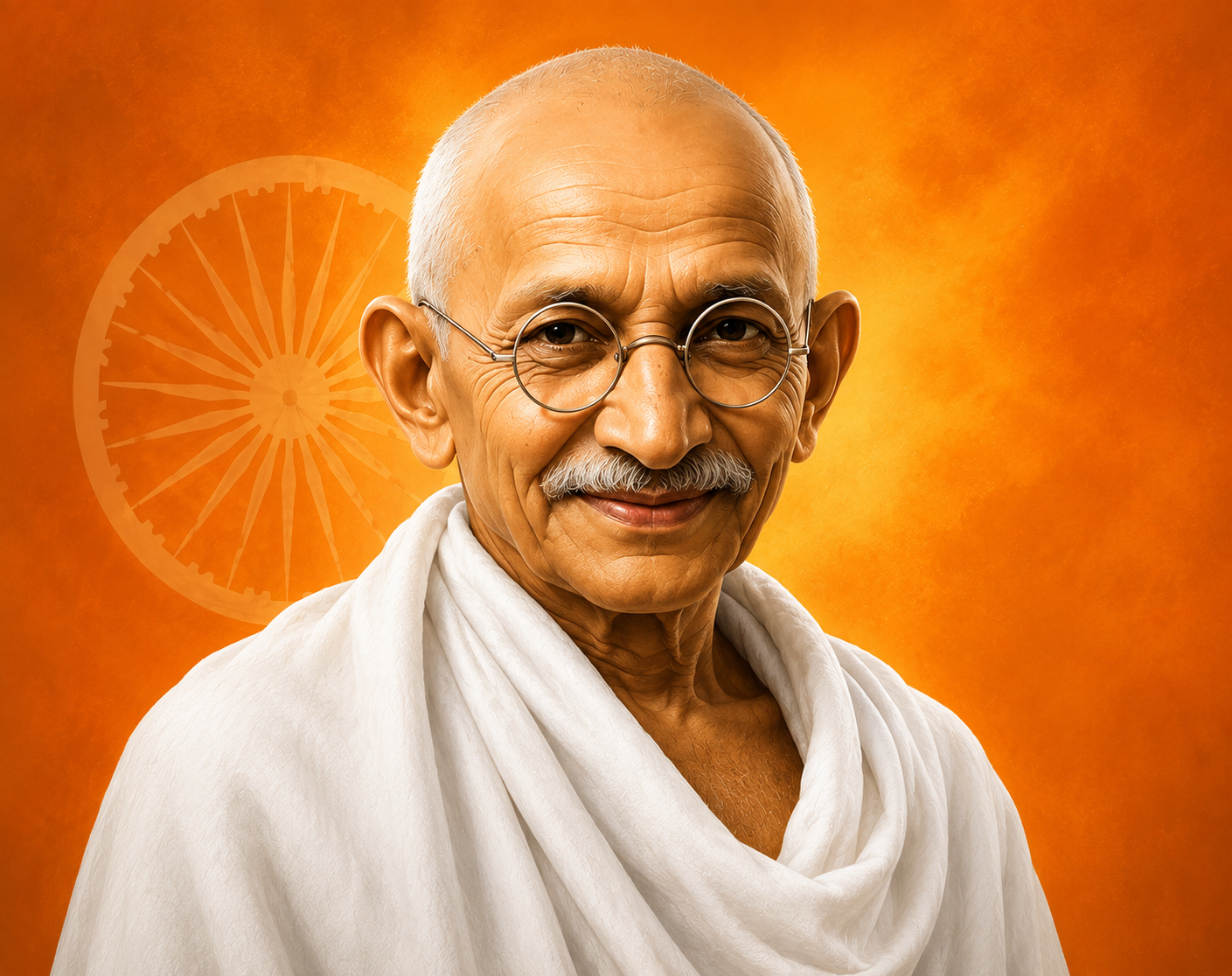
Mahatma Gandhi led India's freedom struggle through truth, non-violence, and peaceful resistance. His philosophy inspired millions across the world.
2 October 1869
30 January 1948
Porbandar, Gujarat
Lawyer • Freedom Fighter
Be the change that you wish to see in the world.
Mohandas Karamchand Gandhi trained as a lawyer in London before spending over two decades in South Africa, where he first developed and tested Satyagraha — his philosophy of non-violent resistance — while campaigning against discrimination faced by Indians.
Returning to India in 1915, Gandhi became a central figure in the freedom movement, leading nationwide campaigns such as the Non-Cooperation Movement, the Salt March to Dandi, and the Quit India Movement. His insistence on truth and non-violence, even in the face of imprisonment and violence, reshaped how the world understood civil resistance.
Revered as the "Father of the Nation," Gandhi's principles went on to inspire civil rights and freedom movements across the globe, from Martin Luther King Jr. in the United States to Nelson Mandela in South Africa.
Born on 2 October in Porbandar, Gujarat, into a Hindu family.
Moves to South Africa, where he confronts racial discrimination and begins shaping Satyagraha.
Returns to India and gradually takes up leadership of the national freedom movement.
Leads the historic 24-day Dandi March in protest against the British salt tax.
Launches the Quit India Movement, demanding an end to British rule.
Assassinated on 30 January, shortly after India achieved independence.