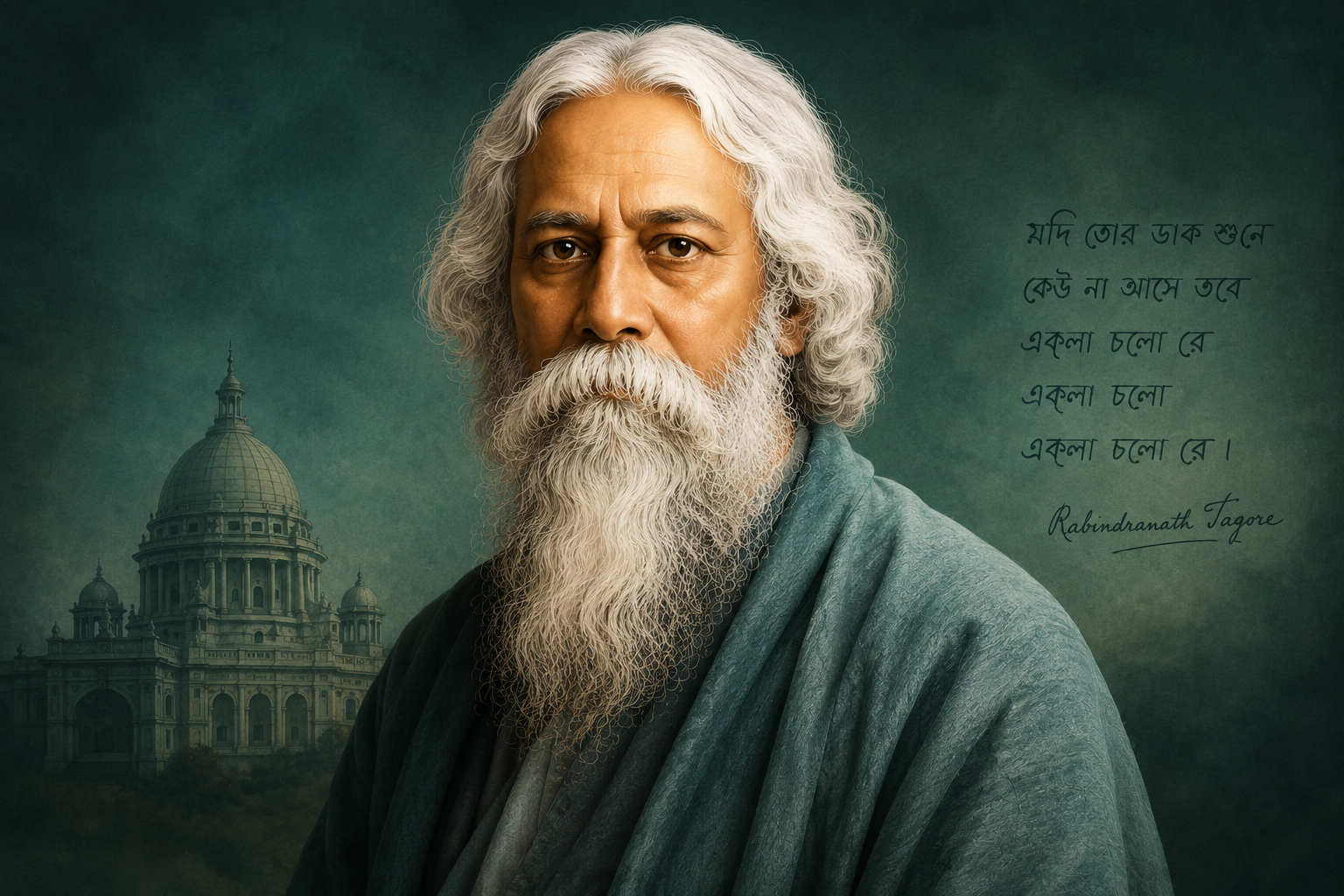
Rabindranath Tagore was one of India's greatest literary figures, whose poetry, songs, novels, and philosophy transformed modern Indian literature. He became the first Asian to receive the Nobel Prize in Literature and remains an enduring symbol of creativity and humanism.
7 May 1861
7 August 1941
Kolkata, West Bengal
Poet • Writer • Philosopher
Faith is the bird that feels the light and sings when the dawn is still dark.
Rabindranath Tagore was born into the famous Tagore family of Kolkata. From an early age he displayed extraordinary talent in literature, music, and art. His writings reflected nature, spirituality, patriotism, and universal humanity.
In 1913, he became the first Asian to receive the Nobel Prize in Literature for his celebrated work Gitanjali. His literary genius introduced Indian philosophy and culture to readers across the world.
Tagore founded Visva-Bharati University at Santiniketan with the vision of creating a place where knowledge could flourish beyond boundaries of nation, religion, and language.
Rabindranath Tagore's influence extends far beyond literature. His educational philosophy, music, paintings, and writings continue to inspire artists, thinkers, and students worldwide. His legacy reminds us that creativity and compassion are essential to humanity's progress.
Born on 7 May into the culturally rich Tagore family of Kolkata, West Bengal.
Founds an experimental school at Santiniketan, rooted in nature and open learning.
Writes the song that would later become India's National Anthem.
Becomes the first Asian Nobel laureate, honoured for his poetry collection Gitanjali.
Establishes Visva-Bharati University, his vision of learning without borders.
Passes away on 7 August in Kolkata, leaving behind an unmatched creative legacy.